
How to Stop Repeating Commands to Your Dog

Your dog sits — but only after you have said "sit" three or four times. The practical answer is simple: give the cue once, help the dog succeed at a level it can handle, and reward the response. Over time, the cue itself becomes the signal to act, instead of the third repetition becoming the signal.
In short:
- Say the cue once — repetitions can quietly become part of the learned pattern.
- If there is no response, reduce the difficulty and reset calmly — no scolding.
- Reward the response you want, in short sessions, starting somewhere easy.
Why Your Dog Waits Until You Repeat a Command
There is no single reason, and it is rarely "stubbornness." Common causes include:
- Inconsistent reinforcement history. If the dog has learned that responding on the first cue sometimes earns nothing and responding on the fourth earns the reward, the pattern makes sense from the dog's point of view.
- Unclear cues. Different words for the same behavior ("sit", "sit down", "park it"), a different tone each time, or a cue that sounds like other words all weaken the signal.
- Distractions. Something more interesting than the cue is competing for attention.
- Training difficulty. The behavior is being asked for too long, too far away, or in too hard a setting for the dog's current level.
- Emotional state. Stress, fear and over-arousal all slow or block responses.
- Physical or sensory limitations. Hearing loss, pain or illness can make a dog appear to "ignore" a cue it genuinely cannot perceive or cannot comfortably perform.
- Insufficient generalization. The dog knows "sit" in the kitchen and nowhere else — not because it is defiant, but because that is where the behavior was learned.
Does Your Dog Actually Understand the Cue?
Before changing how you give commands, check what the dog actually knows. In the quietest, most familiar room, with no distractions, say the cue once in your normal voice. Watch what happens:
- If the dog responds promptly and comfortably several times in a row, the cue is understood at home — and the problem is likely generalization, distraction or reinforcement history.
- If the dog only responds when you add a hand gesture, bend forward or touch a treat pouch, the verbal cue alone is not yet meaningful.
- If the dog looks away, licks its lips, moves away or seems uneasy, the issue may be fear, stress or discomfort rather than understanding.
- If the dog does not respond even with help and clear signals, consider a veterinary check — hearing, pain and other medical issues can all look like disobedience.
What Happens When You Repeat a Cue?
Dogs learn in sequences. If "sit… sit… sit… (dog sits)… reward" happens often enough, the dog can learn that the third "sit" is the real cue — the first two are just background noise. Repetition does not always ruin training, and an occasional repeated cue is not a disaster. But when repetition is the normal routine, the dog has accurately learned the routine you have been teaching.
The practical problem is reliability: a cue that only works on the third try is not a cue yet — it is part of a pattern. The fix is not to repeat more; it is to make the first cue count.
The One-Cue Training Method
This method rebuilds the pattern so that a single cue predicts the opportunity to earn a reward. It is humane, simple and works for dogs of any age.
Step 1: Choose one familiar, easy behavior
Pick a behavior the dog already does well — a sit, a hand target, a down. One behavior at a time keeps the lesson clear.
Step 2: Begin in a low-distraction environment
Start in the quietest room in the house, with no one else moving around and nothing competing for attention.
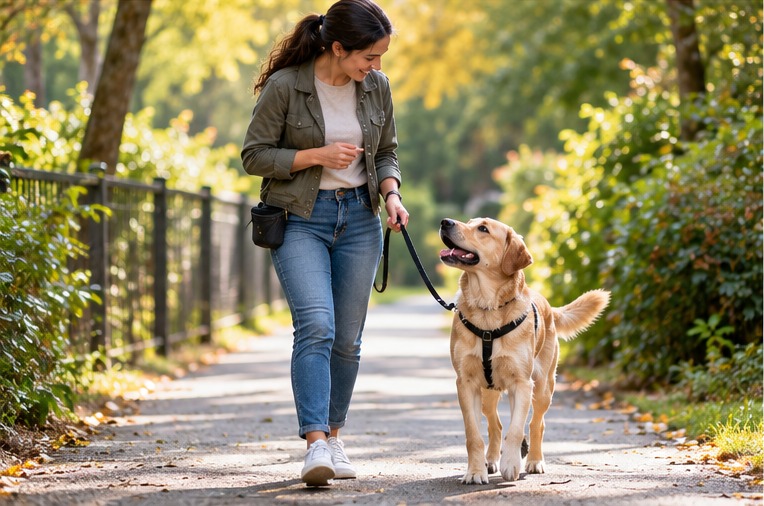
Step 3: Say the cue once
Use the same word, in the same calm tone, once. No trailing repetitions, no "come on… sit… sit." One word, then wait.
Step 4: Allow a reasonable response opportunity
Give the dog a moment to process — a few seconds is plenty for most dogs in an easy setting. The goal is a pause, not a staring contest.
Step 5: Mark and reward a successful response
The instant the dog responds, mark it ("yes!" or a click) and deliver a reward the dog actually values. Timing is everything: the mark should land the moment the behavior happens.
Step 6: If unsuccessful, reduce difficulty or reset without scolding
No response is information, not a crime. Help the dog — show the hand signal, move somewhere quieter, or ask for something easier — then try again. There is no punishment in this step.
Step 7: Repeat in short, successful sessions
Five or six good repetitions beat twenty sloppy ones. End every session while the dog is still succeeding.
Step 8: Gradually practice in new contexts
Once the behavior is reliable at home, move it to new places the same way — one small step at a time. Our guide on proofing around distractions walks through the full progression.
How Long Should You Wait After a Cue?
There is no universal timer. A young puppy learning a new behavior, a senior dog, and a highly trained dog in a quiet room all have different response speeds — and the same dog responds at different speeds in different environments.
As a starting point, wait a few calm seconds in an easy setting before deciding the dog needs help. If responses are consistently slow, the more useful question is not "how long should I wait?" but "what is making this hard?" — the answer is usually difficulty, distraction, or a cue that is not yet clear.
How to Improve Your Dog's Response to Verbal Cues
- Consistent words. Pick one word per behavior and use exactly that word. "Sit" is not "sit down" and not "park it."
- Clear hand signals. Dogs read body language beautifully. A simple, stable hand signal alongside the word gives the dog two ways to get it right.
- Reward timing. The reward should follow the behavior within a second or two, every time, especially while the behavior is new or difficult.
- Reinforcement quality. Use something the dog genuinely wants — for many dogs, that is food; for others, a toy or a quick game. Around distractions, raise the value.
- Gradual fading of prompts. If the dog needs a hand signal or a lure, use it — and then make it smaller and later over time, rather than removing it suddenly. The same logic as fading a treat lure.
- Managing distractions. If the environment is too loud or busy, the cue cannot win. Move somewhere quieter or increase the distance.
When to Re-Teach a Cue From the Beginning
If a cue has been used inconsistently for months — different words, different tones, repeated over and over — the dog may have learned a vague or muddled signal. In that case, the cleanest fix is to re-teach it as if it were new: a fresh word, taught with a clear hand signal, rewarded every time, starting in a quiet room.
Re-teaching is not punishment and it is not starting over from zero — the dog already knows the behavior. You are simply giving the behavior a new, clean name that has no confused history attached to it.
What to Do When Your Dog Still Does Not Respond
| Situation | Possible explanation | Safer next step |
|---|---|---|
| Responds at home, not outside | The cue has not been generalized | Practice the cue in new places gradually, starting quiet |
| Responds only after several repetitions | Repetition has become part of the cue pattern | Switch to one-cue practice with a clear hand signal |
| Responds only with a visible treat | The visible food is part of the cue | Hide the treat and reward after the behavior |
| Seems not to hear you at all | Possible hearing loss or medical issue | Ask a veterinarian to check hearing and overall health |
| Looks away, licks lips, moves off | Stress or fear | Stop the session; make the environment easier; consider professional help |
| Responds slowly or only sometimes at home | Unclear cue or inconsistent rewards | Re-teach with one consistent word and reward every success |
Common Mistakes
- Repeating the same word continuously. Each repetition teaches the dog to wait for the next one.
- Raising the voice. Louder rarely means clearer, and for some dogs it adds stress. Calm and consistent beats loud.
- Practicing only in easy environments. A cue that never leaves the living room stays in the living room.
- Asking for behavior under excessive distraction. If the dog is over its head, no amount of repetition will help.
- Inconsistent rewards. If success sometimes pays and sometimes does not, responding becomes a gamble.
- Ignoring possible discomfort or hearing issues. Before assuming a training problem, rule out a medical one.
A Simple Practice Routine
An adaptable example — adjust the place, the behavior and the number of repetitions to your dog:
| Session | Setting | What to practice |
|---|---|---|
| 1 | Quiet room at home | One cue, one response, reward — 6 to 8 short repetitions |
| 2 | Different room | Same one-cue practice in a new spot indoors |
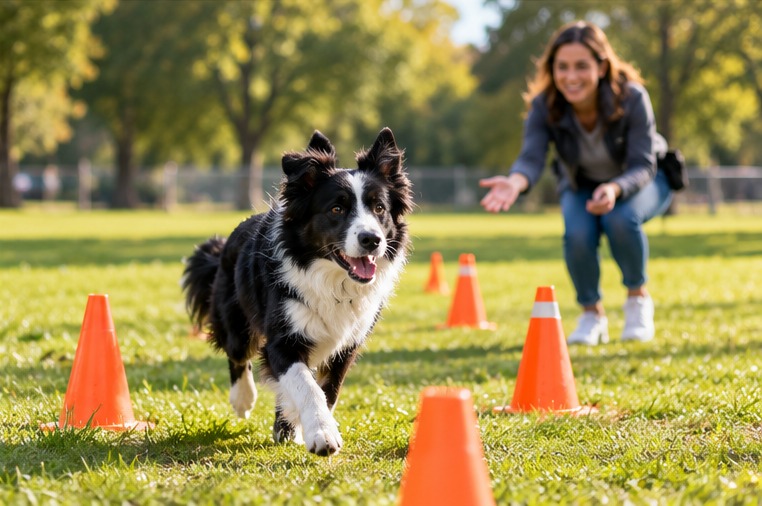
| 3 | Garden or quiet outdoor corner | 5 repetitions with better rewards |
| 4 | Quiet outdoor spot | Same practice with a mild distraction in view, far away |
Keep sessions short, end on success, and practice a few times a week. There are no fixed deadlines — the pace is set by your dog's comfort and success.
When to Consult a Professional
- Sudden changes in responsiveness — if a dog that used to respond reliably suddenly stops, a veterinary check comes first.
- Possible hearing loss — especially in older dogs or dogs that seem startled when approached.
- Pain or illness — limping, reluctance to move, or changes in appetite or energy alongside training difficulties.
- Fear or significant distress — if the dog shuts down, hides or shows stress during ordinary training.
- Persistent training difficulties — when consistent, reward-based practice has not helped over time, a qualified reward-based trainer can watch the full picture in person.
Frequently Asked Questions
Should I say the command only once?
Yes, as a general rule. One calm, clear cue, then wait. If nothing happens, help or reduce difficulty instead of repeating. The occasional accidental repeat will not ruin anything — it is the habit of repeating that matters.
What if my dog ignores the first cue?
Assume the dog needs help, not punishment: check the environment, the dog's state, and whether the cue is truly understood in that setting. Then make the task easier — a hand signal, a quieter spot, or an easier behavior.
Should I repeat the cue more loudly?
No. Volume does not improve understanding, and a raised voice can add stress. A calm, consistent tone is clearer. If the dog may not be hearing you at all, a veterinary hearing check is the right step.
Can I use hand signals?
Yes — and you should. Hand signals are often learned faster than words and give the dog a second clear path to the right answer. You can keep both, or use the signal to support the word while the word gets stronger.
How do I practice outdoors?
Start in the quietest outdoor spot you can find, keep the dog on a leash or long line, and expect to briefly help again — outdoors is a new context even for a behavior that is solid indoors. Build up gradually, one setting at a time.
Conclusion
Stopping the repetition habit is mostly about clarity and honesty with the dog: one cue, one chance, then help or an easier step — never a louder voice or a longer lecture. Rebuild the pattern with the one-cue method, reward real responses, and move to harder settings only as the dog succeeds. If you want to keep strengthening the behavior, our dog training hub has step-by-step guides for the next stages — from fading treat lures to proofing around distractions.
References
This article follows established reward-based training guidance. For further reading: