My Dog Won't Come When Called
You call your dog. They look at you. For a moment, you think they are coming — and then they turn away, keep sniffing, or run in the opposite direction. More than one thing broke the recall — and only one of them is the distance.
Let's Find What Broke the RecallWhy Your Dog Ignores You When You Call
You are at the park. Your dog is thirty feet away, nose buried in something fascinating. You call their name — they look up. You say "come" with your happiest voice — they pause. For one brief second, you think they are about to sprint toward you. Then they put their nose back down and keep sniffing. Or worse — they look at you, turn, and run in the opposite direction. It feels personal. It feels like your dog just told you: you do not matter enough to come back for.
This is one of the most frightening and emotionally charged experiences in dog ownership — because recall is not just about obedience. It is about safety. When your dog ignores recall near a road, around livestock, or in an unfamiliar place, the fear is real. And when recall fails repeatedly, it is easy to spiral into believing your dog does not respect you, does not care about you, or is actively defying you.
None of those explanations are true. Recall failure almost always means one of four things: the cue itself has lost meaning through repetition or negative association; coming back predicts the end of something good like play or freedom; the environment is offering something more valuable than what your recall predicts; or the recall was never systematically trained at this distance, in this environment, with this level of distraction. Each of these has a completely different fix — and applying the wrong fix is why most recall training stalls.
Below, we break down the four reasons your recall is failing — and what to do about each one. Then, use the Response Check to identify which reason best explains your specific situation.
Four Reasons Your Recall Is Failing
Most cases of "my dog won't come when called" fall into one of these four patterns. Read through each one — you may recognize your situation in more than one.
The Recall Word Lost Its Meaning
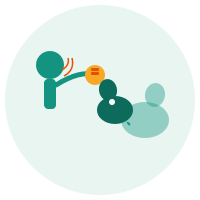
Your dog has heard the recall word hundreds of times — but not all of those times predicted something worth returning for. Repeated, ignored, or negatively paired cues lose their predictive value. The word itself no longer means what you think it means.
Coming Back Ends the Fun
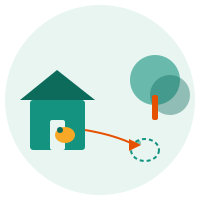
Your dog has learned that coming when called usually means the leash goes on, the park is over, or playtime stops. From their perspective, responding to recall is a losing bet — it means abandoning something good for something worse. This is rational, not stubborn.
The Environment Out-Rewards You
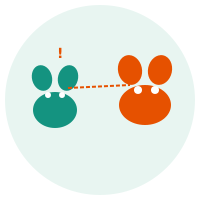
On one side: a squirrel, an incredible smell, another dog, the joy of running. On the other: your voice from across a field. The environment's offer is guaranteed and immediate. Yours is uncertain. Your dog is making a rational cost-benefit calculation — and the environment is winning.
Recall Was Never Built at This Level
Your dog comes in the living room. Maybe in the backyard. But recall was never systematically trained at greater distances, in new places, or around distractions. You have been asking for Level 8 recall when your dog was only prepared for Level 3.
Response Check
Five questions, about 45 seconds. Your responses identify which of the four patterns is most relevant to your situation — so you know exactly where to start rebuilding. No email, no signup, instant result.