My Dog Only Listens When I Have Treats
If your dog only responds when food is visible, more than one thing may have changed — and only one of them is the treat.
Let's Separate What ChangedWhy Your Dog Ignores You When the Treats Disappear
You reach into your pocket, pull out a treat, and your dog sits instantly — eyes locked, tail wagging, every muscle tuned to your next word. You say "sit" without reaching for your pocket, and your dog stares at you as if you've started speaking a language they've never heard before. Same word. Same person. Same room. The only thing that changed was the visible presence of food.
This is one of the most frequently reported training frustrations among dog owners, and the experience itself is genuinely confusing — because from your perspective, everything looks the same. You're giving the same cue. You're standing in the same spot. Your dog clearly knows the behavior because you've seen them do it a hundred times. So why does it only work when the treat bag is visible?
The answer, in most cases, is that more than one variable changed at the same time — but only one of them was the treat. Your dog may have learned to respond to a specific combination of signals, not just the verbal cue you think you're giving. When one piece of that combination disappears, the whole response can collapse — not because your dog is stubborn or disobedient, but because the picture they learned to recognize no longer matches what they're seeing.
Below, we break down the four most common patterns that explain why treat-dependent listening develops — and what you can do about each one. Then, use the Response Check to identify which pattern best matches your specific situation.
Four Patterns Behind Treat-Dependent Listening
Most cases of "my dog only listens when I have treats" fall into one of these four patterns. Read through each one — you may recognize your situation in more than one.
Food Must Be Visible
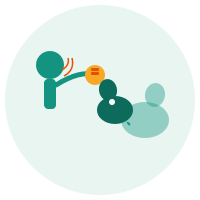
Your dog learned that the sight of the treat — not the verbal cue — is the signal to perform. The treat itself became part of the cue, and without it, the picture is incomplete.
Works Here, Not There
Your dog responds perfectly in the kitchen but ignores you entirely in the backyard or at the park. The behavior was learned in one specific context and hasn't generalized to others.
Works Until Something Better Appears
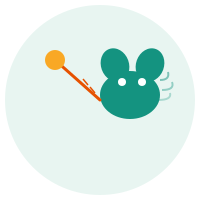
Your dog checks for treats, sees none, and weighs the competing motivators in the environment — a squirrel, another dog, an interesting smell — and those win. Every time.
The Reward Pattern Changed
You used to reward every correct response, but gradually phased treats out — and the behavior faded with them. The transition from continuous to intermittent reinforcement happened too quickly.
Response Check
Five questions, about 45 seconds. Your responses identify which of the four patterns is most relevant to your situation — so you know exactly where to focus your training. No email, no signup, instant result.