My Dog Barks at Everything
A delivery truck. A person walking past. A cupboard opening. Another dog outside. Each trigger sounds the same bark — but each one might come from a completely different place. Separate the pattern before you try to change it.
Let's Find Which Pattern Is Driving ThisWhy Your Dog Barks at Everything — and Why It Feels Like Everything
The delivery driver pulls up. Your dog barks. A person walks past the window. Your dog barks. You open the cupboard. Your dog barks. You sit down after a long day — and another small noise sets off another round. By the end of the afternoon, it feels like your dog is reacting to every single thing that moves, makes a sound, or exists. You are exhausted. Your neighbours have noticed. And you have started to wonder whether this is just who your dog is now.
This is one of the most mentally draining experiences in dog ownership — because barking is loud, public, and impossible to ignore. It interrupts sleep and work. It creates tension with neighbours. It makes you tense up every time a car slows down outside. And underneath all of that noise is a genuine fear: what if this never stops?
Here is what matters: "barks at everything" is an owner's summary, not a single behavioral pattern. The same bark — same pitch, same volume, same duration — can mean completely different things depending on what happened right before, what the dog is looking at, and what makes the barking stop. A dog barking at a passerby from the window is doing something different from a dog barking because they learned it gets attention. A dog barking after an hour of accumulated excitement is doing something different from a dog barking because someone just left the house. Treating all four with the same strategy — ignoring, tiring out, correcting — can strengthen the wrong mechanism while leaving the real pattern untouched.
Below, we separate the four patterns behind barking that sounds the same — and what to do about each one. Then, use the Response Check to identify which pattern best explains your specific situation.
Four Patterns Behind the Same Bark
Most cases of "my dog barks at everything" fall into one of these four patterns. Read through each one — you may recognize your situation in more than one.
Everything Becomes an Alert
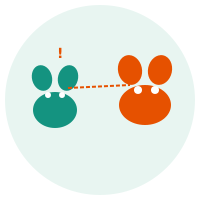
Your dog scans the environment and responds to triggers as they appear. A delivery, a passerby, a car door — each one sets off the same sequence. The barking stops when the trigger leaves, which reinforces the pattern: bark, and the thing goes away. Over time the trigger list grows.
Barking Makes Things Happen
Your dog has learned that barking reliably changes what people do. Someone looks, speaks, opens a door, throws a toy or provides food. Even if it only works sometimes, intermittent success makes the behavior stubbornly persistent.
The System Never Settles
Multiple events stack throughout the day — walks, visitors, play, noises — and your dog never returns to baseline between them. By the time barking starts, they are not reacting to the last trigger. They are reacting to the cumulative load of the last several hours.
It Starts When Someone Leaves
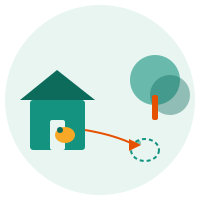
The barking is tied to who is absent, where the dog is confined or what access is blocked. It may happen behind a gate, in a crate, in a separate room or when alone. This is not automatically separation anxiety — context matters.
Response Check
Five questions, about 45 seconds. Your responses identify which of the four patterns is most relevant to your situation — so you know exactly where to start. No email, no signup, instant result.